Sericin vs Fibroin: What Is the Difference? (2026)
 By Livora Team3 min readUpdated
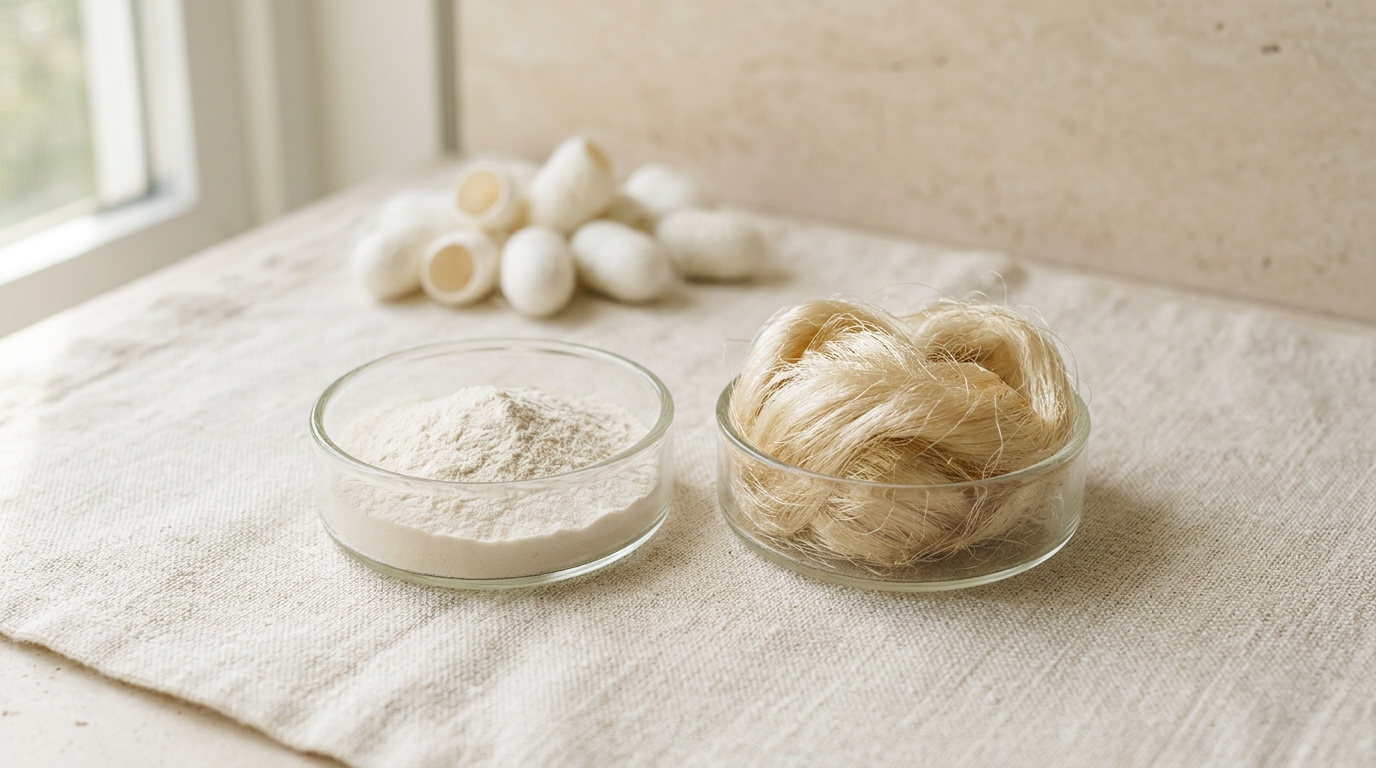
Open a silk cocoon and you will find two proteins working together. One forms the strength. The other holds everything in place. In cosmetics, people often use the two names as if they meant the same thing. They do not.
In this guide, we explain what each protein is, how they differ, and which one fits which product. We make both kinds of ingredient in Ramanagara, Karnataka, so we also share what we see buyers confuse.
What is fibroin?
Fibroin is the structural protein of silk. It forms the long, strong fibre at the centre of every thread. It is the protein that gives silk its strength and its sheen.
For cosmetic ingredients, fibroin is broken into smaller pieces. These become silk peptide and silk amino acids. Whole fibroin can also be milled into a silk powder.
What is sericin?
Sericin is the gum-like coating around the fibroin fibre. It glues the threads together inside the cocoon. It is rich in serine, an amino acid that attracts water, and it dissolves in warm water. Our full explainer is in What is sericin?.
How do sericin and fibroin differ?
| Sericin | Fibroin | |
|---|---|---|
| Where it sits | The outer coating | The inner core fibre |
| Role in the cocoon | Holds fibres together | Gives strength and structure |
| Water behaviour | Water-soluble | Not soluble in its natural form |
| Typical cosmetic forms | Sericin powder, hydrolyzed sericin, solutions | Silk powder, silk peptide, silk amino acids |
| What formulators use it for | Moisture-retaining feel, film, conditioning | Soft feel, slip, conditioning |
Which ingredients come from which protein?
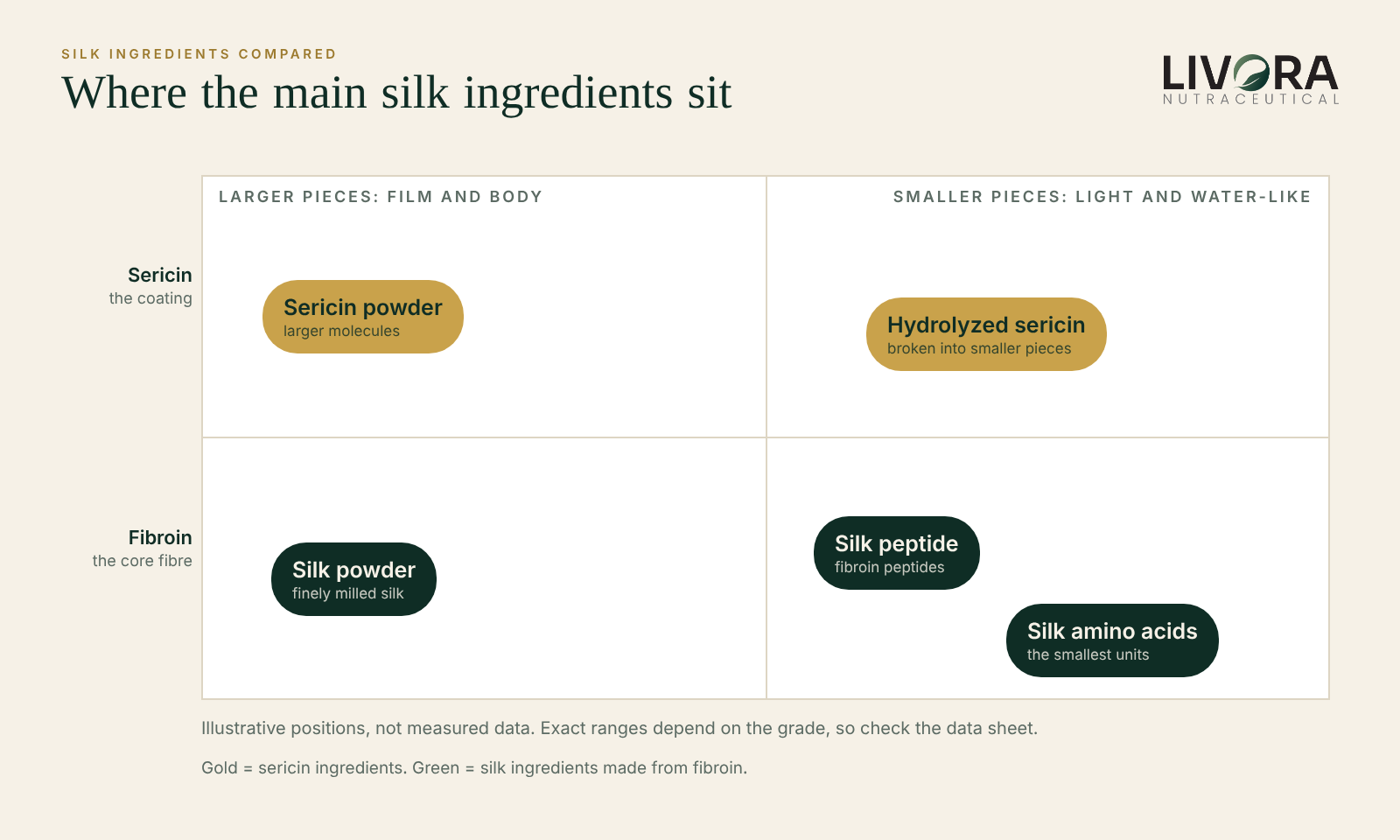
- From sericin: Sericin Powder, Hydrolyzed Sericin and Hydrolyzed Sericin Solution.
- From fibroin: Silk Powder, Silk Peptide, Silk Peptide Solution and Silk Amino Acids.
- Combined: Silk Protein Complex blends molecular weights.
How to choose between them
- Start with the product. Toners and serums suit smaller, lighter grades. Creams, masks and hair conditioners can use larger, film-forming grades. Makeup powders use silk powder.
- Pick the effect you want. For a moisture-retaining film, look at sericin. For a soft, smooth feel, look at silk peptide or amino acids.
- Compare two sizes. One smaller and one larger grade, in your own base.
- Ask for documents. A data sheet, a certificate of analysis and a safety data sheet should come with the sample. See our guide to TDS, COA, SDS and INCI.
Common mix-ups
- "Silk protein" means one thing. It does not. It covers several ingredients from two proteins.
- Sericin is silk. Silk fibre is mainly fibroin. Sericin is the coating.
- Hydrolyzed means better. It means smaller. Smaller suits light products, not every product.
- Natural means vegan. Both proteins come from silkworm cocoons, so they are animal-derived.
Final thoughts
Fibroin is the strong core. Sericin is the water-loving coating. Choose by product type, then by size, and test in your own base.
Not sure where to start? Contact us with your product type and market, and we will suggest a grade.
Frequently asked questions
What is the main difference between sericin and fibroin?
Fibroin is the strong core fibre of silk. Sericin is the water-soluble coating around it. They are different proteins with different amino acid profiles and different roles.
Which is better for cosmetics, sericin or fibroin?
Neither is better in general. Sericin suits moisture-retaining, film-forming and conditioning uses. Fibroin-derived ingredients, such as silk peptide and silk amino acids, suit conditioning and a soft feel. Choose by product type.
Is silk peptide made from sericin or fibroin?
Silk peptide is made from fibroin that has been broken into smaller pieces. Hydrolyzed sericin is made from sericin.
Are sericin and fibroin both animal-derived?
Yes. Both come from silkworm cocoons, so neither is suitable for vegan products.
Can I use both in one formula?
Yes. Some formulators combine them to get both a film and a light feel. Test the combination in your own base.
Written by
Livora Team
Silk protein ingredients, Ramanagara, Karnataka
We make sericin and silk fibroin ingredients for cosmetics in Ramanagara, Karnataka, from cut cocoons.
Our guides explain what each ingredient is and how formulators use it, in plain language.
Keep learning
 Silk proteins
What Is Sericin? A Formulator's Guide (2026)
Sericin is the protein that holds silk fibres together. Learn how it is made, what it does in cosmetics, and how to choose the right grade.6 min read Silk proteins
Hydrolyzed Sericin vs Sericin Powder: Which One to Use (2026)
Hydrolyzed sericin and sericin powder differ in molecular weight and feel. Learn how to choose between them for toners, serums and creams.3 min read Buying guide
Sourcing Silk Protein From India: 10 Questions to Ask (2026)
Buying sericin or silk peptide from India? Ten questions to ask any supplier about source, documents, batches, samples and shipping.3 min read Silk proteins
Silk Peptide vs Silk Amino Acids vs Silk Powder (2026)
Silk peptide, silk amino acids and silk powder all come from silk fibroin. Learn how they differ and which suits your product.2 min read