TDS, COA, SDS and INCI Explained: A Buyer's Guide (2026)
 By Livora Team5 min readUpdated
You found an ingredient you like. The sample feels right. Then comes the part that decides whether you can use it: the paperwork.
A supplier who sends clear, complete documents quickly usually controls their process. A supplier who hesitates, or sends one vague page, is telling you something too. In this guide, we explain the four documents you should expect, what each one tells you, when to ask, and what to watch for.
We make silk protein ingredients, so some examples use sericin and silk peptide. The advice applies to any cosmetic raw material.
What are cosmetic ingredient documents?
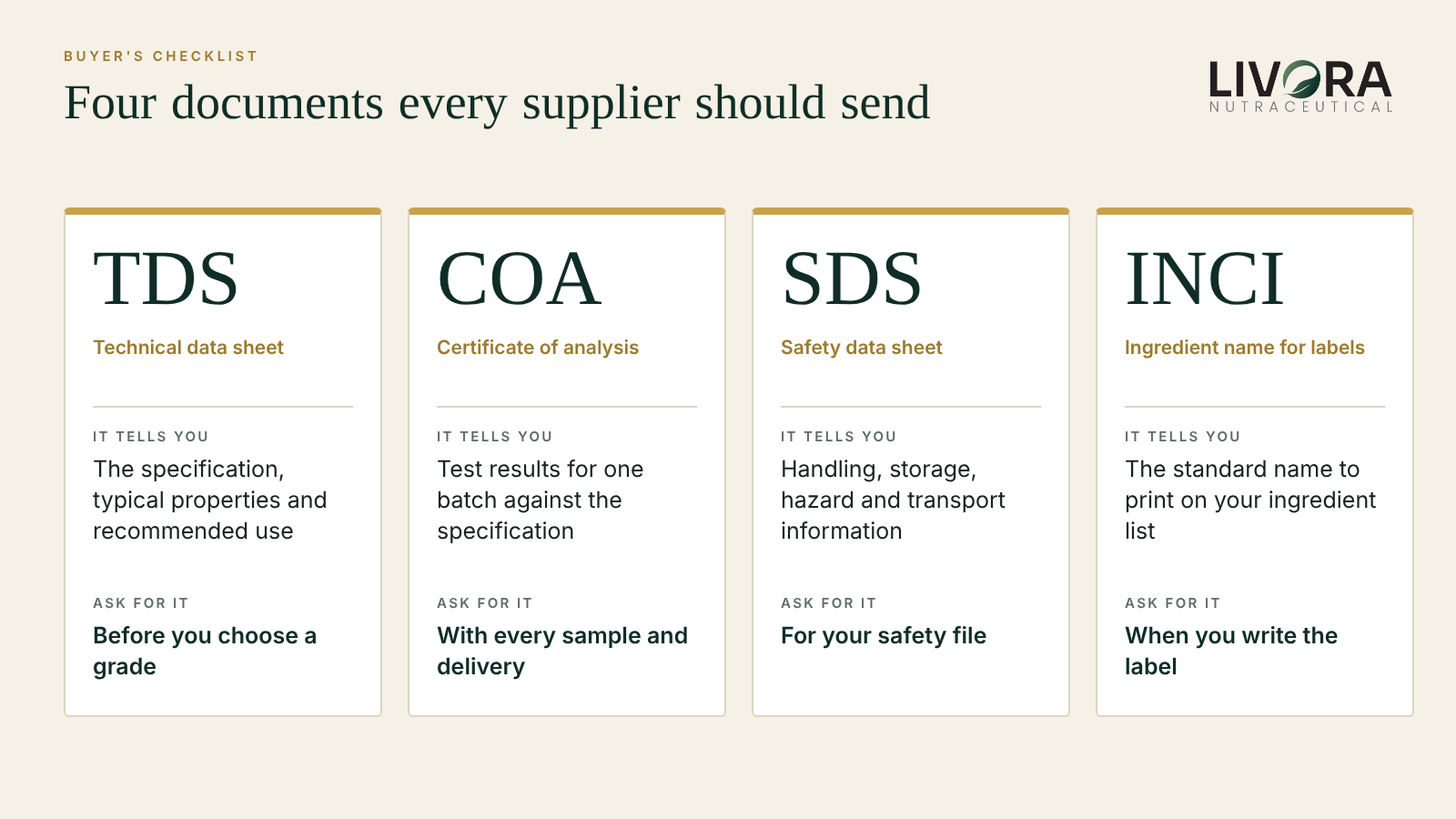
Cosmetic ingredient documents are the papers that describe an ingredient and prove what a specific delivery contains. Four matter most:
| Document | What it tells you | When to ask for it |
|---|---|---|
| Technical data sheet (TDS) | The specification, typical properties, recommended use and storage | Before you choose a grade |
| Certificate of analysis (COA) | Test results for one batch, compared with the specification | With every sample and every delivery |
| Safety data sheet (SDS) | Handling, storage, hazard and transport information | For your safety file and warehouse |
| INCI name | The standard name to print on your product label | When you write the ingredient list |
What is a technical data sheet (TDS)?
The TDS describes the ingredient in general. You use it to compare grades and plan a formula.
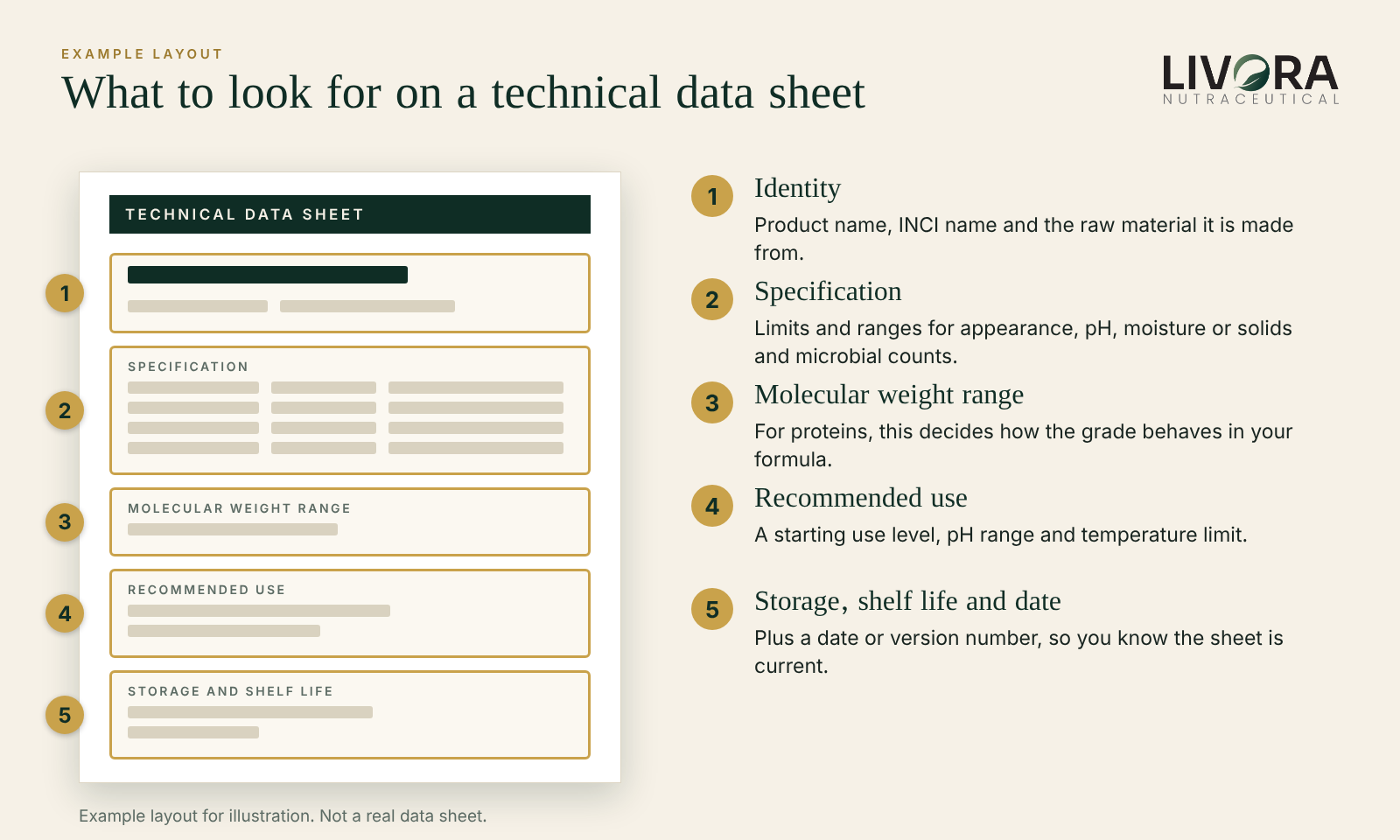
What a good TDS contains
- Identity. Product name, INCI name and what the ingredient is made from.
- Specification. Limits for appearance, colour, odour, pH, moisture or solids, and microbial counts.
- Molecular weight range (for proteins). It decides how the grade behaves in your formula.
- Recommended use. A starting use level, the pH range and the temperature limit.
- Storage and shelf life.
What to check
A TDS should give ranges and limits, not only adjectives like "high purity" or "excellent quality". It should also carry a date or version number, so you know it is current.
What is a certificate of analysis (COA)?
The COA reports the real results for one batch. It shows whether the batch you are about to receive meets the specification on the TDS.
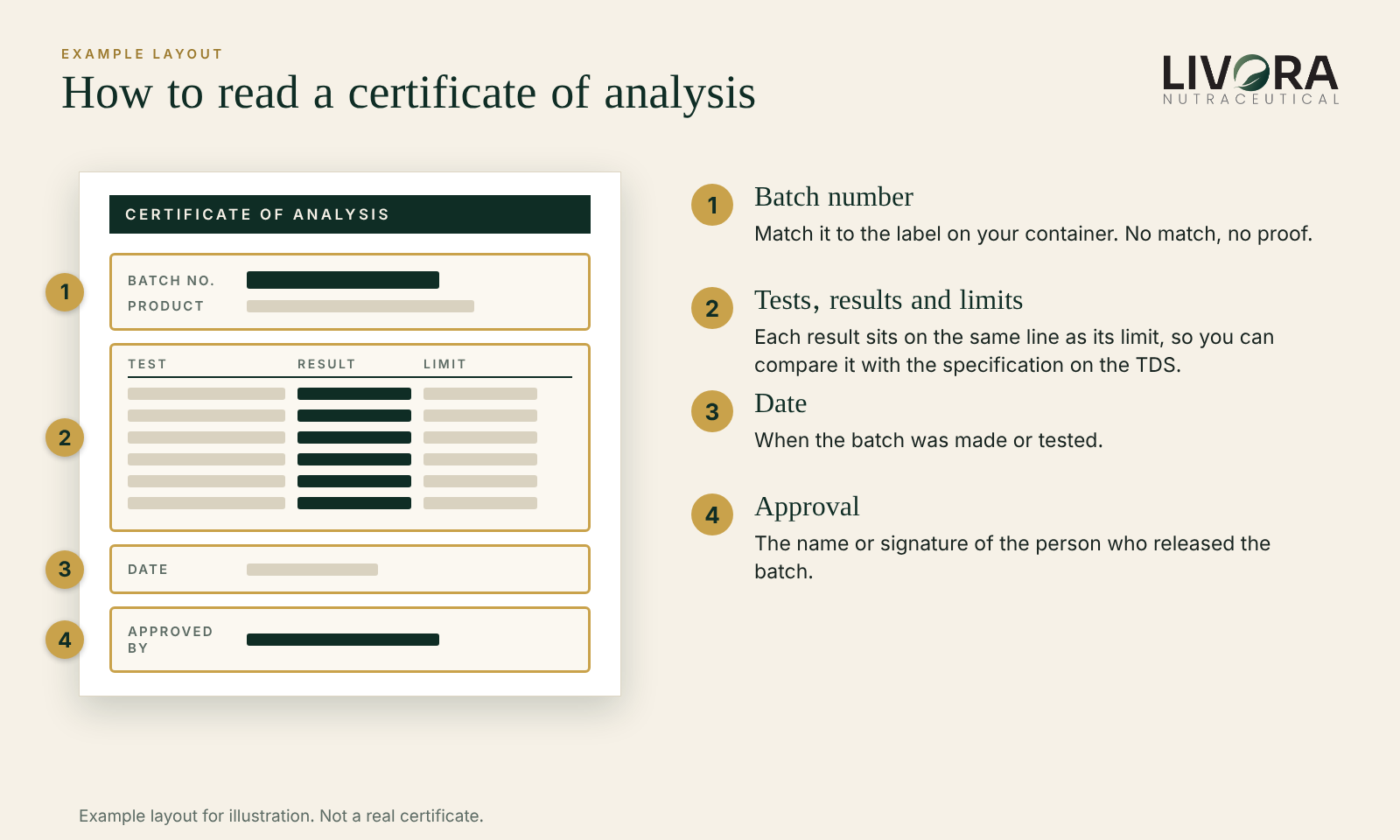
How to read a COA
- Match the batch number on the COA to the label on the container.
- Compare each result with its limit. Both should be on the same line.
- Check the date of manufacture or testing.
- Look for an approval, such as the name or signature of the person who released the batch.
A "typical" COA is useful when you evaluate a grade, but it is not a record of your batch. Ask for a new COA with every delivery.
What is a safety data sheet (SDS)?
The SDS covers handling, storage, first aid, fire-fighting, spills and transport. Your warehouse and your safety file need it.
An SDS follows a standard structure, so you can check quickly that all the sections are present. An SDS with missing sections, no date, or no supplier address deserves a question.
What is an INCI name?
INCI stands for International Nomenclature of Cosmetic Ingredients. It is the naming system used for ingredient lists on cosmetic products. Ask the supplier which INCI name belongs to the grade you are buying, and use that name exactly.
If a supplier is unsure of the INCI name for its own product, treat that as a warning.
When to ask for which document
You do not need every document on day one. Ask for them in the order you need them:
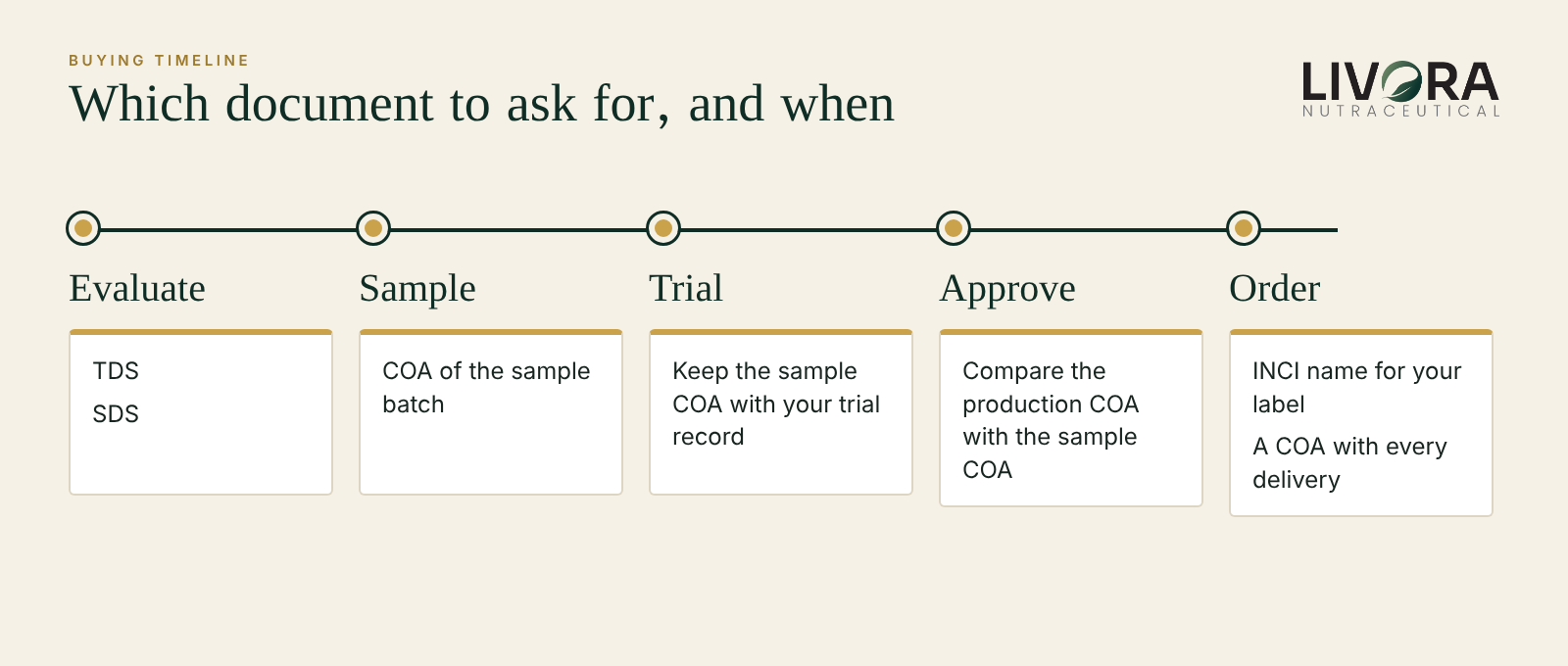
- Evaluate: ask for the TDS and SDS. They tell you whether the grade fits.
- Sample: ask for the COA of the sample batch.
- Trial: keep the sample's COA with your trial record.
- Approve: compare the production COA with the sample's COA.
- Order: ask for the INCI name for your label and a COA with every delivery.
Five red flags in a supplier's paperwork
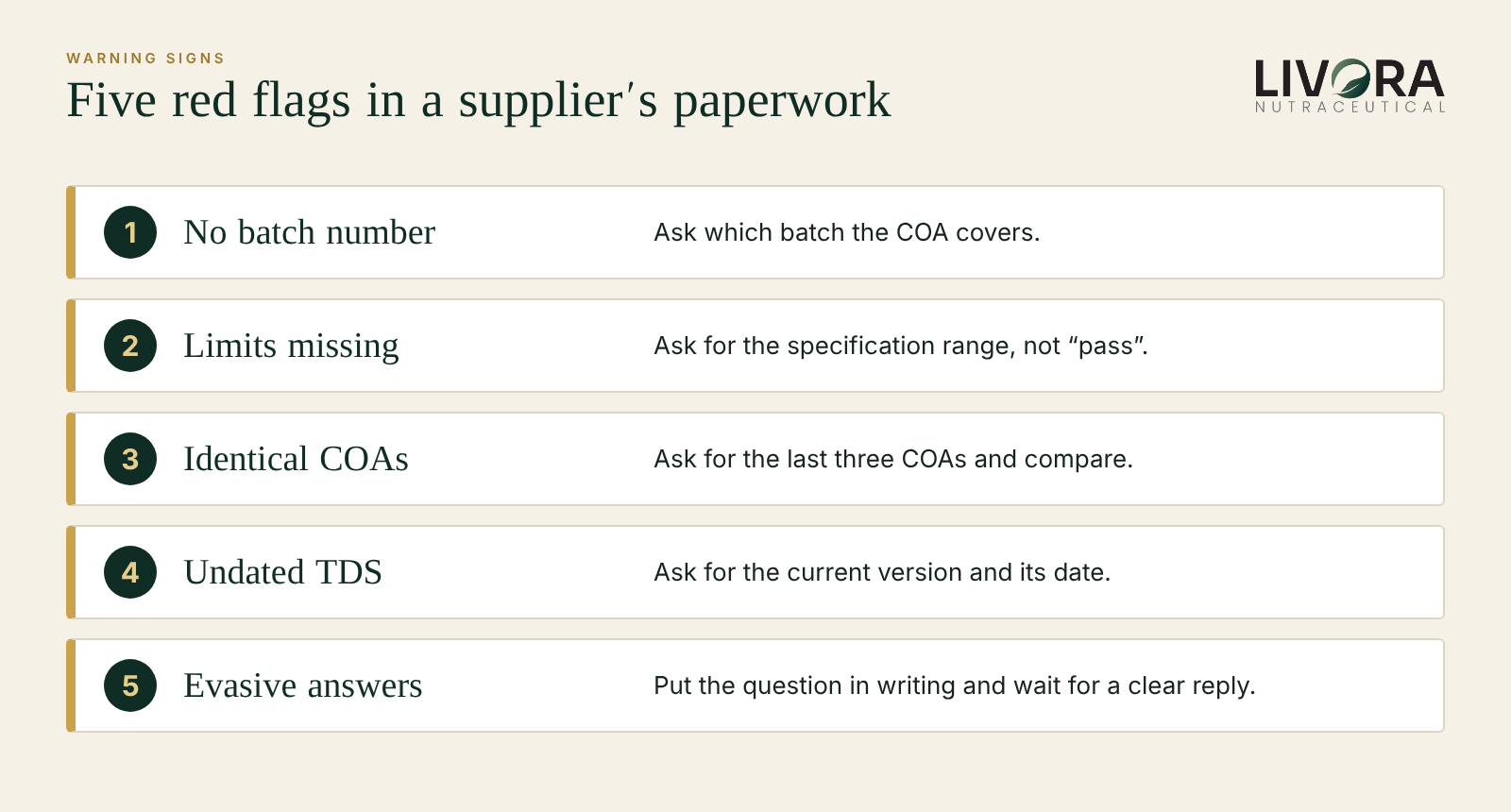
- No batch number on the COA, or a number that does not match the pack.
- Specifications with no limits, such as "pass" instead of a range.
- The same COA every time, with identical results for different batches.
- A TDS with no date or version, so you cannot tell if it is current.
- Slow or evasive answers to a simple question, such as the molecular weight range or the raw material source.
A checklist to keep
- I have the TDS for the exact grade I will buy, with limits and ranges.
- I have a COA for the sample or batch, and the batch number matches.
- I have the SDS, and it is dated.
- I know the INCI name for my ingredient list.
- I know the shelf life and storage conditions.
- I can trace the batch back to its source.
What Livora sends with a sample
For every silk protein ingredient we send the technical data sheet, the certificate of analysis for the batch sent and the safety data sheet, and we tell you the INCI name for the grade. If you have a supplier questionnaire of your own, send it with your request and we will complete it.
Final thoughts
Documents are how a supplier shows its work. Ask for them early, read the limits and ranges, match the batch number, and treat slow answers as information. A supplier who makes this easy is usually one you can build a product on.
Not sure which grade to start with? Contact us with your product type and market. We will recommend a grade and send the documents with your sample.
Frequently asked questions
What is the difference between a TDS and a COA?
A TDS describes the ingredient in general: its specification, typical properties and recommended use. A COA reports the actual test results for one specific batch and shows whether that batch met the specification.
Do I need an SDS for a cosmetic ingredient?
Yes. The safety data sheet covers handling, storage, hazards and transport. You need it for your safety file and for your warehouse, even if the finished product is harmless.
What is an INCI name?
INCI stands for International Nomenclature of Cosmetic Ingredients. It is the standard name printed on a cosmetic product's ingredient list, so the same ingredient has the same name in every market that uses INCI.
When should I ask a supplier for documents?
Ask for the TDS and SDS before you choose a grade, and ask for a COA with every sample and every production batch.
Can a COA be the same for every batch?
It should not be. A COA reports one batch, so results usually differ slightly from batch to batch. Identical results to the last decimal on different batches are a warning sign.
What documents does Livora send with a sample?
We send the technical data sheet, the certificate of analysis for the batch sent and the safety data sheet, along with the INCI name for the grade. Contact us with your product type to request them.
Written by
Livora Team
Silk protein ingredients, Ramanagara, Karnataka
We make sericin and silk fibroin ingredients for cosmetics in Ramanagara, Karnataka, from cut cocoons.
Our guides explain what each ingredient is and how formulators use it, in plain language.
Keep learning
 Silk proteins
What Is Sericin? A Formulator's Guide (2026)
Sericin is the protein that holds silk fibres together. Learn how it is made, what it does in cosmetics, and how to choose the right grade.6 min read Silk proteins
Sericin vs Fibroin: What Is the Difference? (2026)
Sericin and fibroin are the two proteins in silk. Learn where each comes from, how they differ, and which one suits your cosmetic product.3 min read Formulation
How to Trial Silk Protein in a Formula: A 6-Step Plan (2026)
A practical plan for trialling sericin or silk peptide in a cosmetic formula: what to prepare, compare, measure and record.3 min read Silk proteins
Silk Peptide vs Silk Amino Acids vs Silk Powder (2026)
Silk peptide, silk amino acids and silk powder all come from silk fibroin. Learn how they differ and which suits your product.2 min read